Strategy
Why Small-Batch Production Is Keeping Boutique Brands Alive While Big Retailers Go Broke
Small batch apparel manufacturing for boutique brands isn't just a trend — it's the financial model keeping independents solvent while big retailers collapse under unsold stock.
Small batch apparel manufacturing for boutique brands has quietly become one of the smarter financial decisions in U.S. retail — not because it's fashionable, but because the alternative is killing companies. Joann Fabrics, Express, and Rue21 all filed for bankruptcy between 2023 and 2025. Excess inventory was a core pressure in every single case. These weren't badly run businesses. They were running a production model that no longer fits how demand actually moves.
Why large retailers are drowning in unsold stock right now
The U.S. apparel industry collectively wrote off an estimated $50 billion in excess inventory in 2022 and 2023. That number comes from NRF and McKinsey reporting on the post-pandemic overbuy collapse, and it's staggering when you sit with it. Brands ordered heavily when demand looked strong, production lead times were long, and by the time the goods landed, the moment had passed.
Dead inventory doesn't just cost you the unit price. Storage fees, markdown losses, and liquidation typically add 30 to 60% on top of your original cost of goods, according to supply chain finance analysis from Stord. So a $200,000 inventory problem quietly becomes a $280,000 to $320,000 problem before you've sold a single discounted unit. That math breaks balance sheets.
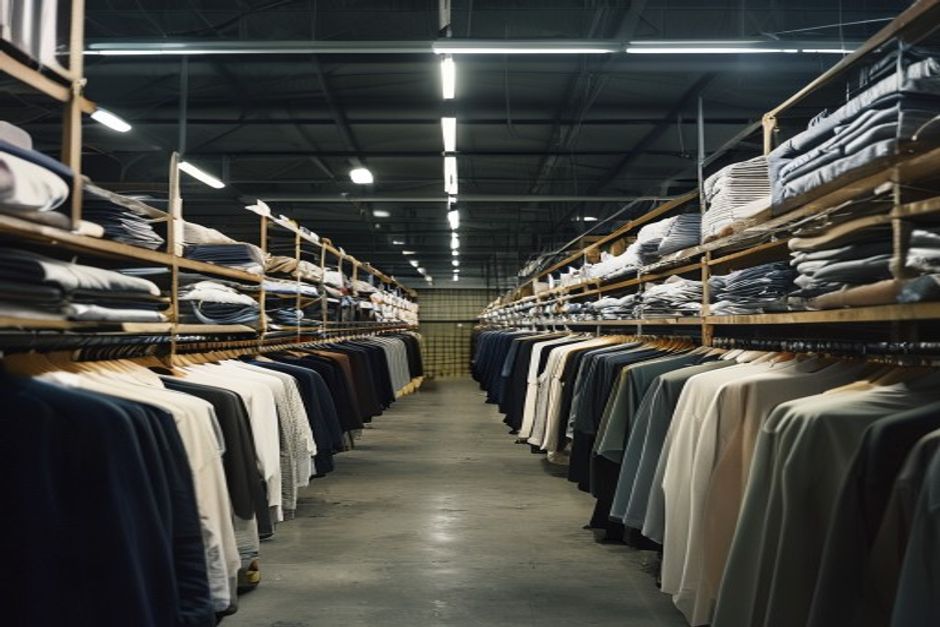
How overbuying became structural for big brands and why small brands can avoid it
A large retailer placing orders 12 to 16 weeks out is essentially guessing demand six months in advance. Once fabric is cut, you're committed. There's no course-correcting, no reading the market, no pausing when a colourway isn't moving. The lead time forces the decision long before you have real data.
Big brands built their entire supply chains around this model because the unit economics made sense at scale. Buy 10,000 units and the per-piece cost is low enough to absorb some waste. But if you're a boutique brand selling 200 to 2,000 units per style, that logic falls apart completely. You don't have the volume to absorb the waste, and you don't have the marketing budget to clear it.
Shopify reported a 31% increase in independent apparel store GMV between 2022 and 2024. These brands are growing, but they're doing it without the safety nets that big retailers have. That means inventory risk hits them harder and faster. The smart ones are structuring their production to match how they actually sell.
What 'small batch' actually means in production terms
People use 'small batch' loosely. Let's be specific about what it means at the factory level.
A 50-unit MOQ means you're cutting and sewing 50 pieces of a single style. That's genuinely low. Most factories won't touch anything under 300 to 500 units because the setup time per style eats into their margin at lower volumes. At 50 units, a boutique brand can test a new style for roughly $1,500 to $4,000 in production cost depending on garment complexity. A 500-unit minimum elsewhere puts you at $15,000 to $40,000 for the same style. That's not a small difference in financial exposure.
Here's the part that makes small batch actually useful as a strategy rather than just a lower buy: a brand ordering 50 units in three colourways is testing three separate market bets for the same cash outlay as one 150-unit bulk order. And each of those bets gives you real sell-through data before you scale anything. That's not possible when you're committing to 500 units of each.
The nearshore lead time advantage and why it changes your reorder logic
A 4 to 6 week lead time from Colombia to a U.S. port isn't just faster. It changes how you can structure your entire buying calendar. If your first drop sells through 70% in the first two weeks, you can place a reorder and have product on hand before the demand window closes. With a 12 to 16 week lead time, that reorder arrives after the moment is gone.
This is the real operational advantage of nearshore small-batch production for boutique apparel. You're not just saving on inventory risk with the first order. You're building a feedback loop that lets each drop inform the next one. That's a genuinely different business model from the traditional seasonal buy.
Real numbers: what a 50-unit run costs versus sitting on 500 unsold units
Let's run it plainly. A 50-unit run of a mid-complexity garment — say a structured woven top with screen printing — will typically land between $28 and $60 per unit in production cost depending on fabric, print complexity, and finishing details. Call it $2,000 to $3,000 total. You sell through 40 units at $95 retail. You've covered production, made margin, and learned which size curve actually moves.
Now compare that to holding 500 unsold units at $30 cost each. That's $15,000 in goods. Add 40% for warehousing and markdown losses, and you're sitting on a $21,000 problem. Liquidate at 30 cents on the dollar and you recover $4,500 on a $15,000 investment. That's the dead inventory trap. It's not a dramatic collapse — it's a slow bleed that kills cash flow quarter after quarter.
How duty-free access under the Colombia-U.S. Trade Promotion Agreement affects your landed cost
The U.S.-Colombia Trade Promotion Agreement has been in force since 2012. For qualifying garments made in Colombia, the duty rate into the U.S. is 0%. For comparable apparel categories sourced from countries without an FTA, you're looking at 12 to 32% in import duties on the declared value of the goods.
On a $3,000 production order, a 20% duty rate adds $600 before your goods even clear customs. On larger orders, the duty difference is substantial enough to meaningfully shift your landed cost calculation. It's not a secondary consideration — it should be part of every cost comparison you make.
Full-package production, meaning fabric sourcing, cutting, sewing, finishing, and screen printing handled by one factory, also reduces coordination costs significantly. For brands without a dedicated production manager, chasing multiple vendors across multiple countries to assemble a finished garment is expensive in time if not always in direct fees.
What boutique brands need to have ready before placing a small-batch order
A small MOQ doesn't mean a low-information order. The factory still needs to cut and sew precisely, which means you need to show up prepared.
- A tech pack or detailed flat sketch with measurements and construction notes. Photos of inspiration garments are a starting point, not a substitute.
- Fabric specifications, or enough information to let the factory source appropriately. 'Something like linen but softer' is not a fabric spec.
- A clear size run. If you want 50 units split across XS to XL, that's 10 units per size. Know that going in.
- Artwork files for any screen printing at 300dpi minimum, vector preferred. Low-res JPEGs cost you sample rounds.
- A realistic timeline. A 4 to 6 week production window starts after sampling is approved, not from the day you first make contact.
The brands that struggle with small-batch production aren't struggling because of the factory. They're struggling because they arrive without the information a factory needs to work from. Getting this right on the front end is what keeps your lead times honest.
When small-batch nearshore production is the wrong call
It's worth being straight about this. Small-batch nearshore isn't the right answer for every brand or every order.
Small batch also doesn't solve a brand problem. If your design isn't resonating, producing 50 units instead of 500 just means you find out faster. That's actually useful, but don't mistake the production model for a product strategy.
And if you need goods in three weeks because you've already announced a launch date without lining up production, no factory at any MOQ can reliably fix that. Lead times are real constraints, not negotiating positions.

If you're running 50 to 2,000 units per style and want to understand what a nearshore small-batch programme would actually cost for your specific garments, send us your tech pack and we'll give you straight numbers.
Get a quote