Production basics
Why Fabric Hand Feel Is the Production Spec Most Brands Forget to Write Down
How fabric hand feel affects garment quality is rarely written into specs — and that gap costs brands samples, time, and retail returns. Fix it here.
Ask most brand founders what specs they send to a factory before sampling and you'll get a reasonable answer: tech pack, BOM, colourway references, maybe a fit block. What you almost never hear is anything about how the fabric should feel against skin. That omission is where a lot of first samples go wrong. Understanding how fabric hand feel affects garment quality isn't a textile nerd obsession — it's the difference between a sample your buyer picks up and approves in thirty seconds and one that gets rejected before they've checked a single seam.
What hand feel actually means at the factory level
Hand feel isn't a vague aesthetic preference. At the factory level it refers to a set of measurable mechanical and surface properties: stiffness, smoothness, compressibility, surface friction, and the way a fabric recovers after deformation. These are the things your fingers are registering when you pick up a fabric and know within a few seconds whether it's right.
The industry has actual measurement tools for this. The Kawabata Evaluation System, KES, quantifies these properties on numerical scales. It measures bending rigidity, tensile behaviour, surface roughness, and compression characteristics in a way that gives factories a reference they can check against a standard. So when a brand says 'it should feel silky,' a factory with KES data can at least anchor that to something real. Without it, 'silky' means whatever the pattern maker decides it means that morning.
Most small and mid-size brands don't have access to KES testing. That's fine. But that makes the physical swatch even more important, not less. A fabric sample in hand communicates more than a page of written descriptors.
The fabric properties that determine how a garment feels against skin
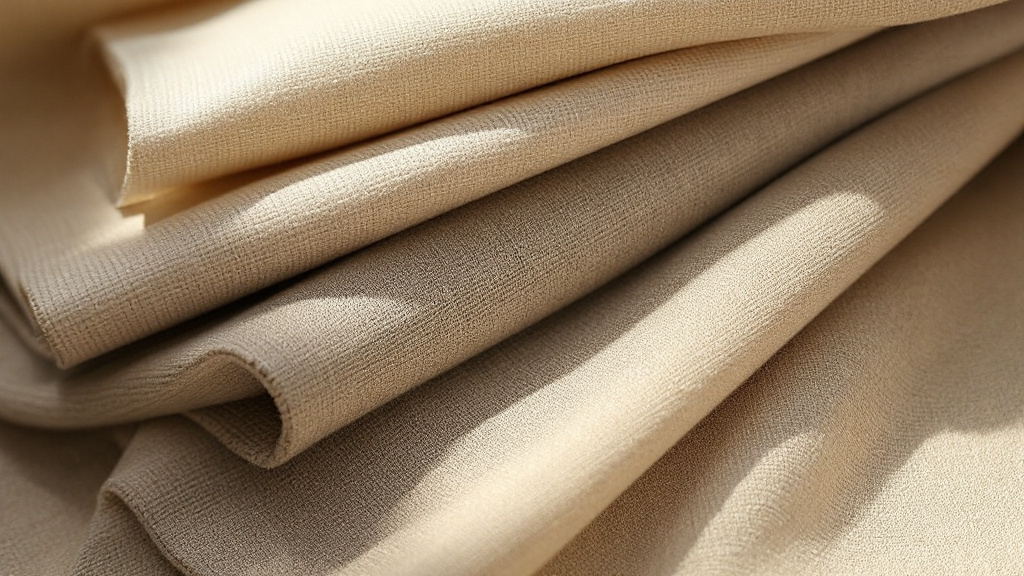
Four things drive hand feel more than anything else: fibre content, yarn construction, weave or knit structure, and finishing. They don't operate independently. A change in any one of them shifts the total tactile experience of the finished fabric.
Fibre content is the foundation. Cotton absorbs moisture and breathes. Polyester doesn't, though modern microfibre engineering has closed that gap considerably on feel even if not on breathability. Linen starts stiff and softens with washing. Wool has a warmth and resilience that synthetic fibres can approximate but never fully replicate. Knowing the fibre is step one.
Yarn construction matters more than most brands realise. Ring-spun cotton yarns produce a smoother, softer hand feel than open-end spun yarns at the same weight because ring spinning aligns the fibres more tightly along the yarn axis, reducing the loose surface fibres that create that slightly rough or fuzzy texture. A retail buyer can detect this difference in under ten seconds of handling. It affects perceived quality at a price point where you can't afford to lose the comparison.
Weave and knit structure then determine how those yarns interact under load, how the fabric drapes, and how much air passes through it. And finishing — enzyme washes, calendering, brushing, softener treatments — can significantly alter the base feel of a fabric, for better or worse.
Why hand feel specs almost never appear in tech packs (and what that costs brands)
The honest answer is that most brand-side people who build tech packs were taught to spec construction, not feel. They know to write down stitch count per inch, seam allowance, and hem width. Hand feel sits in the gap between fabric sourcing and production, and it falls through that gap constantly.
What it costs depends on where in the process you catch the problem. If you catch it at first sample, you're looking at 2-3 weeks added to your sampling cycle, a new fabric order, and another sample round. If you catch it at bulk approval, you're looking at a fabric substitution negotiation with your factory and potentially a delay to your delivery window. If you don't catch it until your retail buyer handles the product, you're looking at a rejection or, worse, a return rate problem after sell-through.
In our experience, brands sourcing at 50-300 units who can't provide a physical fabric swatch for hand feel matching are statistically more likely to reject their first samples. Not because the factory made mistakes — but because there was no shared reference point for what the fabric should feel like. Digital fabric specs don't communicate feel. A photograph of a fabric tells you nothing about its stiffness or surface friction.
How fabric weight, weave structure, and fibre content interact to produce feel
This is where a lot of brands get confused. Weight and feel are not the same thing. A 5.5 oz/sq yd cotton poplin and a 5.5 oz/sq yd cotton jersey are the same weight on a scale and feel completely different against skin. The poplin is a tight plain weave with a smooth, slightly crisp hand. The jersey is a single-knit structure with stretch and drape and a softness the poplin can't match. Same fibre, same weight, different fabric architecture, entirely different tactile experience.
This matters practically when you're substituting fabrics. If your approved fabric becomes unavailable and a factory proposes a substitute at the same weight and fibre content, that's not enough information. You need to know the weave structure and the finishing before you can say whether the substitution is valid.
Finishing treatments compound this further. Enzyme washing can reduce stiffness in cotton twills by 30-40%, which is a meaningful shift in hand feel. The same twill, un-washed, is considerably stiffer and more formal in drape. Both might be 8 oz/sq yd. Neither is wrong. But they're not the same fabric for production purposes.
What happens when a factory substitutes a fabric without matching the hand feel
Fabric substitutions happen. Mills run out of stock. Colours dye differently on a new shipment. A supplier changes their yarn source without announcing it. These are real production realities. The question is whether the substitution is managed with hand feel as a specification or whether it's managed purely on price and availability.
When a factory substitutes without matching hand feel, the result is usually a garment that measures correctly and looks correct in photographs but doesn't feel right in the buyer's hands. The seams are fine. The construction is clean. But something is off. Buyers often can't articulate it precisely. They just know the product isn't what they signed off on.
The polyester microfibre category is a good example. These fabrics can be engineered to very closely mimic the hand feel of silk at a fraction of the cost. But the dye uptake is different, and colour behaviour under UV light differs significantly from natural silk. For indoor apparel that might not matter. For outdoor categories or swimwear where sun exposure is constant, that UV colour shift becomes a quality issue and a return driver. A factory that substitutes a microfibre on a silk spec without flagging the UV behaviour difference has technically matched the hand feel and created a real problem downstream.
How to communicate hand feel requirements in a way factories can actually act on
Here's what actually works. In order of reliability:
- Send a physical fabric swatch with your tech pack. Label it clearly as the hand feel reference. This is the most reliable method by a wide margin.
- If you have a reference garment — a competitor product, a vintage sample, anything with the hand feel you're targeting — send it. The factory can reverse-engineer the fabric properties from a physical reference.
- If you're writing descriptors, be specific and comparative. 'Soft like a washed Oxford cloth shirt' is more useful than 'soft.' 'Stiff enough to hold a collar stand without fusing' is more useful than 'structured.'
- For performance fabrics, request KES data from your fabric supplier if you can get it. Even one or two KES parameters — bending rigidity, surface friction — give a factory something numerical to match against.
- If you're working with a mill rather than buying off-the-shelf fabric, specify the finishing treatments you want and ask for wash-stability confirmation. Don't assume the sample finish is the same as what will be applied at bulk.
Colombian textile mills supplying performance and fashion fabrics can turn around hand feel matched substitute swatches within 5-7 business days for most knit categories. That's a meaningful advantage when you're trying to keep a sampling cycle tight. Comparable requests through Asian mill agents typically run 3-5 weeks, and that's before you factor in the freight time to get a physical swatch in hand.
The difference between hand feel for woven vs knit vs stretch garments
These three fabric categories have different hand feel priorities, and mixing up the criteria is a common mistake.
For wovens, the primary feel concerns are drape (how the fabric moves and falls), surface texture (smooth vs textured, crisp vs soft), and structure (how much the fabric holds its shape vs collapses under its own weight). A suiting fabric needs enough bending rigidity to hold a lapel. A blouse fabric needs enough drape to fall cleanly from the shoulder.
For knits, stretch and recovery become central. A jersey that stretches easily but recovers slowly will bag out at the elbows and knees. The feel of a knit against skin is also more immediate than a woven, because knits conform to the body more closely. Pilling resistance, which is partly a surface friction property, matters more in knits than most other categories.
Stretch wovens add another variable: the elastane content and its distribution affect the hand feel in ways that don't show up in a static drape. A stretch denim that feels right flat on a table may feel uncomfortably rigid when it's on a body in motion. In our production experience, hand feel mismatches are most common when brands approve a digital fabric specification rather than a physical swatch, and this is especially true for performance knits and stretch wovens going to the U.S. market, where consumer expectations for stretch garment feel are high.
Why luxury retail buyers reject garments on touch before they inspect construction
There's a reason experienced buyers pick up a garment before they look at it closely. Touch registers faster than vision for quality assessment, and for fabric feel especially, the hand gives an immediate verdict that the eye then either confirms or overrides.
At retail price points above $80 per garment, consumer return data consistently shows that fabric feel ranks alongside fit as a top-two return reason, ahead of colour and ahead of construction defects. That's a striking statistic if you're a brand that puts most of your QC effort into seam inspection and measurement checking. The construction can be perfect and the garment still fails commercially because the fabric doesn't feel like the price.
Luxury buyers have internalised this. They've handled enough fabric across enough years that their touch calibration is accurate and fast. A fabric that has been finished with a softener to mask underlying stiffness often passes visual inspection and then gets flagged on touch. An open-end spun yarn masquerading as ring-spun through a heavy softener treatment has a specific surface texture that doesn't quite behave right when you handle it. It's not magic. It's pattern recognition built on repetition.
The practical implication for brands is that hand feel is not a soft spec you sort out later. It's a primary quality parameter, on the same level as fit and construction. It needs to be defined before sampling, confirmed at sample approval, and audited at bulk. If your tech pack doesn't include a hand feel reference, it's incomplete, and you're leaving a significant quality variable to chance.
If you're heading into a new production run and want to discuss how to spec fabric hand feel in a way your factory can actually match — from sample through bulk — send your project details to Procesarte and we'll tell you exactly what we need from you before sampling begins.
Get a quote