Production basics
The Trim Problem: Why a $0.12 Zipper Is Quietly Destroying Your Premium Brand
Cheap zippers and trim hardware quietly destroy premium garments. Here's what the specs actually cost, what failures really cost, and how to fix it.
The reason why cheap zippers ruin premium garments isn't complicated, but it surprises brands every time it happens to them. You've spent real money on fabric, on a clean cut, on solid construction, and then a $0.12 zipper pull oxidises after two washes, or a snap pops off a jacket the third time someone wears it, and that's the thing the customer remembers. Not the fabric. Not the stitching. The zipper. Trim hardware is the last thing most brands specify and the first thing that fails in the field. That's a fixable problem, and this post is about how to fix it.
What trim hardware actually does to a garment's perceived quality
Trim is tactile. When someone picks up a jacket in a boutique or pulls it out of a shipping bag, they touch the zipper before they look at the seams. The weight of a slider, the smoothness of a pull, the way a button sits in its hole — these things communicate quality instantly, before the customer has thought about it consciously. A heavy brass zipper on a $200 jacket tells a story. A light, slightly rough zinc-alloy pull on the same jacket tells a different one.
This isn't subjective. Consumer perception studies on apparel quality consistently show that hardware and closures rank among the top three tactile quality signals, alongside fabric hand and seam finish. Brands that spend $18 per yard on a deadstock Italian wool and then spec a generic zipper are making a category error. The trim is visible, touchable, and functional. It gets stress every single time the garment is worn. And it fails in ways that fabric rarely does.
There's also a durability dimension that compounds the perception problem. A garment that fails mechanically — zipper separates, button detaches, snap pops — is returned. A garment that just looks cheap after ten washes gets quietly abandoned. Both outcomes are bad for a brand, but only the return shows up in your data. The abandoned garment shows up in your repeat purchase rate, and that number is harder to diagnose.
The real cost difference between cheap and spec-grade zippers
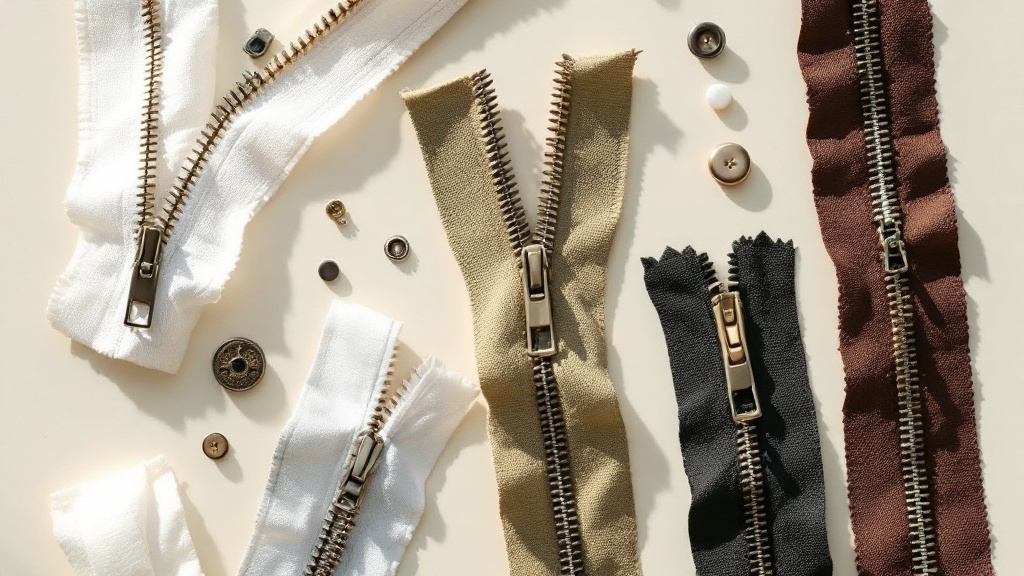
Here's the actual maths, because this is where brands talk themselves out of upgrading and later regret it. A standard off-brand metal zipper runs $0.08 to $0.14 per unit at production quantities. A YKK equivalent in the same gauge — say, a #5 nylon coil or a #5 metal — runs $0.22 to $0.38 per unit, depending on length and finish. That's a delta of roughly $0.15 to $0.25 per garment. On a 500-unit run, you're looking at $75 to $125 in total additional trim cost to go from generic to spec-grade. That's it.
Now consider what a 4% return rate driven by zipper failure costs on that same 500-unit run at a $120 retail price point. Twenty returns. Reverse logistics alone — return shipping, processing, inspection — typically runs $8 to $12 per unit in the U.S. market. That's $160 to $240 in logistics costs, minimum. Add restocking labour, customer service time, and the units you can't resell because they came back damaged or outside your return window, and you're easily at $2,400 in total direct cost from that one failure mode. The zipper upgrade would have cost $125.
The brands that push back on trim costs are almost always the ones doing the maths wrong. They're comparing trim cost to nothing, instead of comparing trim cost to failure cost. Those are very different calculations.
Where zipper and hardware failures show up first: pull-strength and cycle testing numbers
YKK is the world's largest zipper manufacturer, controlling roughly 40 to 45% of global zipper supply. Their #5 and #8 nylon coil zippers carry documented pull-strength ratings. Off-brand equivalents rarely match those ratings, and more importantly, they rarely document them at all. When you ask a generic trim supplier for pull-force data, you usually get silence or a vague spec sheet that references a standard without showing results.
Cycle testing is where the gap becomes clearest. Zipper sliders rated for fewer than 500 open-close cycles are common in low-cost trim. That sounds like a lot until you think about how often a jacket zipper gets used. A person who wears a jacket four times a week, zipping and unzipping twice each time, hits 500 cycles in about 15 months. YKK and equivalent spec-grade sliders are typically rated to 1,000 to 2,500 cycles depending on the application. That's the difference between a zipper that lasts the garment's useful life and one that fails in its second season.
Corrosion is the other failure mode that brands consistently underestimate, especially for swimwear, beach cover-ups, or coastal resort wear. Zinc-alloy pulls exposed to salt water and UV can show surface oxidation after as few as 10 wash-and-dry cycles in chlorinated or salt water conditions. If your product is designed for that environment, you need marine-grade or at minimum brass-finished hardware with documented corrosion resistance, not whatever generic metal pull your factory sourced locally because it was in stock.
Buttons, rivets and snaps: the specs brands forget to lock in before production
Zippers get most of the attention, but buttons, rivets, and snaps fail too, and the compliance stakes can be higher. Button attachment strength is measured by pull force in pounds. A button sewn with four-hole lockstitch construction should withstand at least 15 lb of pull force per ASTM D4833 standards before detachment. That's a testable, documentable spec. Most brands never ask for it, and most factories never test it unless they're working with a buyer who requires it.
For childrenswear and infant apparel, snap fasteners are a federal compliance issue, not just a quality issue. Snaps on garments intended for children under 3 years old are subject to mandatory CPSC pull-force testing under U.S. law. If your factory sources snaps without compliance documentation, you can face import holds or recalls. This isn't hypothetical — it happens to small brands who trusted their factory to handle trim without explicit written specs. The documentation burden is yours as the importer of record. Make sure your tech pack requires the factory to provide it.
Rivets on denim are another category where brands assume the factory knows what they're doing and end up with hardware that scratches furniture or skin, or that pops under normal stress. The rivet spec should include material (solid brass, copper, or alloy), cap diameter in inches, and back-plate construction. If it's not written down in your tech pack, the factory is making those choices for you based on what's cheapest and most available.
How trim failures drive return rates and customer complaints in ecommerce
In brick-and-mortar retail, a trim failure usually results in an exchange. In ecommerce, it results in a return request, a review, and sometimes a chargeback. The customer can't hand the garment back across a counter. They have to photograph it, package it, print a label, drop it off somewhere, and wait. That friction makes them angrier. And they're far more likely to leave a review about it.
A single viral review mentioning a broken zipper on an otherwise well-made jacket can suppress conversion on that product for months. Brands underestimate how specifically customers describe trim failures in reviews. They don't write 'poor quality.' They write 'the zipper pull broke off after two wears' or 'the button came off the first time I washed it.' That's searchable, it's indexed, and it sits on your product page doing damage indefinitely.
The other ecommerce-specific problem is that trim failures cluster. If a zipper specification is wrong, it's wrong across the entire production run. A 4% failure rate doesn't mean four garments out of a hundred fail randomly. It might mean all the failures happen in the first two months, because that's when the worst sliders in the batch are being cycled hardest. You get a spike in returns, a spike in reviews, and a permanent mark on a product that you might have had to discontinue anyway.

What a complete trim spec looks like and where it goes in your tech pack
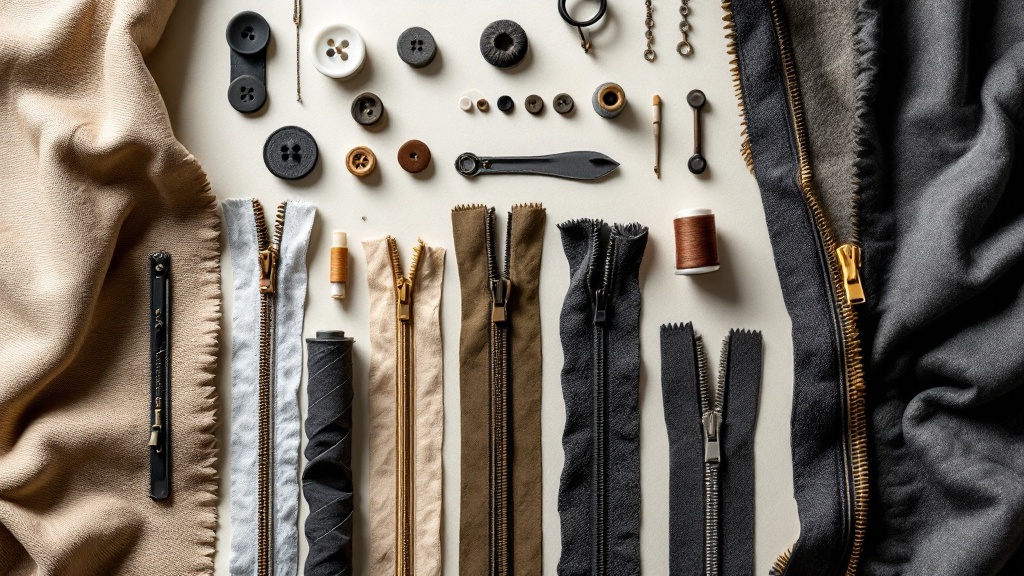
A complete trim spec is a separate page in your tech pack, not a footnote on the BOM. It should cover every non-fabric component that gets attached to or included with the garment. Here's what that list actually looks like for a mid-complexity woven top or jacket.
- Zipper: manufacturer name, product code, gauge (#3, #5, #8), type (coil, metal, invisible), length in inches, slider style, pull shape, finish, and colour reference (Pantone or manufacturer code)
- Buttons: material (natural horn, polyester, metal), size in inches or ligne, hole count, attachment method (two-hole, four-hole, shank), and minimum pull-force requirement in pounds
- Snaps: manufacturer, size, material, finish, application method (hand-set, machine), and for childrenswear, CPSC compliance documentation reference
- Rivets: material, cap diameter in inches, back plate construction, finish
- Labels: woven or printed, content and care label per FTC requirements, placement and attachment method
- Thread: brand and colour code (Gutermann, Coats, or similar), separate call-out for any visible topstitching or contrast thread
- Hangtags and packaging: attachment method, barcode placement, folding and poly-bag spec if applicable
Thread colour-matching deserves its own call-out because it's one of the most commonly botched specs. Thread colour for visible seams or topstitching is a separate specification from your body fabric colour. If you just tell the factory 'match the fabric,' they will match it approximately using whatever thread is in stock, and you will get colour drift on finished garments. Specify a Pantone reference or a thread manufacturer colour code. Gutermann, Coats, and Amann all publish colour systems that factories can order against. Use them.
How a factory should be approving and storing trim before a cut begins
Trim approval is a distinct pre-production step, and it has to happen before cutting starts, not alongside the finished sample. This distinction matters more than most brands realise. If trim is approved from the finished sample, you're approving it after the production batch has already been ordered. Any issues you find mean re-ordering trim, delaying the cut, and potentially missing your delivery window.
The right sequence is: brand submits tech pack with trim spec, factory sources trim and submits a physical trim card or approved sample to the brand for sign-off, brand approves or requests substitution in writing, factory places trim order against the approved spec, trim arrives and is checked against the approval card before fabric is cut. That's five steps, and most brands skip steps two through four entirely.
On the factory side, approved trim should be stored separately from general trim inventory, tagged with the production order number, and issued to the cutting room against that specific order. It shouldn't be possible for a cutter to grab a different zipper because the approved one is temporarily out of reach. That sounds like an obvious process, but in practice, it requires physical organisation and someone responsible for enforcing it.
One of the practical advantages of nearshore production for U.S. brands is that the trim approval round becomes a real exchange rather than a logistics event. With four sailing days between Barranquilla and Miami, a physical trim card can be sent to a brand team in New York or Los Angeles and reviewed within a normal business week. That same round trip to an Asian supplier takes three to five weeks by air courier for anything requiring a physical sample. The speed difference means brands sourcing from Colombia can actually run trim approvals properly without blowing their pre-production timeline.
When upgrading trim is the single highest-ROI change a brand can make
Not every brand needs to upgrade every piece of trim. A $30 retail basics brand sourcing 10,000 units probably can't absorb $0.25 per unit across the board without repricing. But for any brand selling above $80 retail, especially in direct-to-consumer ecommerce where returns are expensive and reviews are permanent, trim is almost certainly the highest-return quality investment available. The maths are simply too clear.
The brands that benefit most from a trim audit and upgrade are the ones that have already solved their fabric and construction quality but are still seeing return rates above 3%, or whose customer reviews mention hardware specifically. If you're hearing 'great fabric, but the zipper feels cheap' more than once, you already know what the problem is. The fix costs a few hundred dollars on a production run. The continued problem costs a multiple of that every season, compounding in review scores and repeat purchase rates.
The best time to fix a trim spec is before the next production run. Not mid-run, not after returns spike. Before the cut. That means getting the spec right in the tech pack now, sending it to your factory with enough lead time to source and approve the correct trim before the cut begins, and building trim approval into your production calendar as a non-optional step.
If you're preparing a tech pack for your next run and want a factory that will flag trim issues before the cut rather than after, send your spec to Procesarte and we'll tell you exactly what we'd require to approve it.
Get a quote