Sourcing
Does Colombian Manufacturing Actually Make Sense for Your Brand? A Honest Cost Breakdown
A Colombian clothing manufacturer for small fashion brands isn't always the right call. Here's the honest landed cost math, with real numbers.
If you're a U.S. boutique brand researching a Colombian clothing manufacturer for small fashion brands, you've probably seen a lot of vague promises about quality and speed. What you haven't seen is a straight answer about whether the numbers actually work for your specific situation. So let's do that instead.
What kind of brand actually benefits from nearshore production
The brands that get the most out of Colombian manufacturing are typically doing 100 to 2,000 units per style, selling at retail price points above $60, and working with styles that have some construction complexity. Think woven shirts, swim, outerwear, structured trousers, or anything with real cut-and-sew detail.
If you're launching a line and you need 50 units of a tailored linen blazer to test the market, nearshore makes sense. If you're trying to produce 80 units of a $38 retail plain t-shirt, it probably doesn't, and we'll get to why.
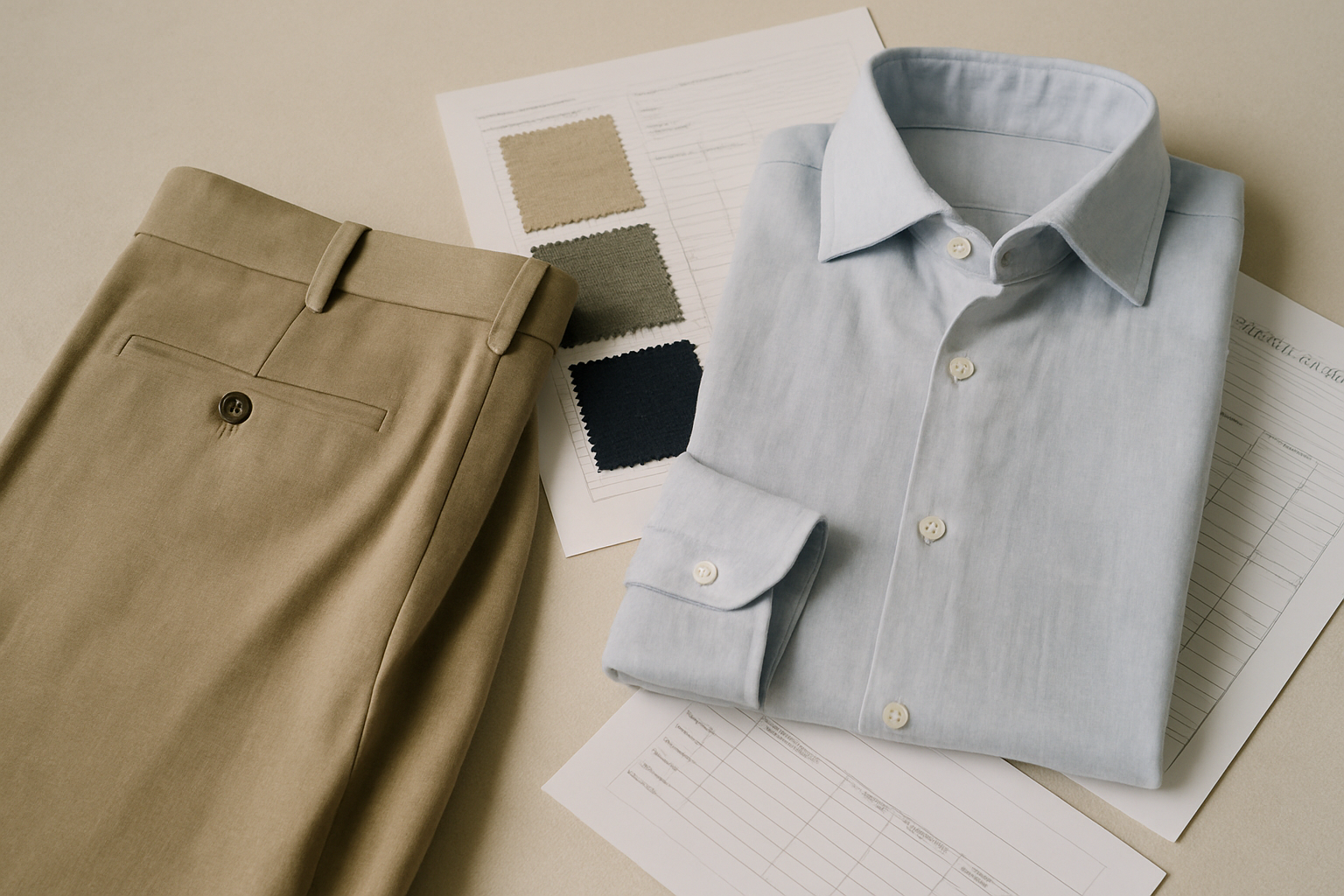
The real landed cost calculation: CMT, duties, freight, and time
Landed cost is what a garment actually costs you by the time it's in your warehouse, ready to ship to a customer. CMT plus materials is only the start. You also have freight, duties, customs brokerage, and any packaging you've had done at the factory.
Air freight from Medellín to Miami or New York typically runs $4 to $6 per kg for small commercial shipments. A standard woven shirt weighs around 300 to 400 grams finished, so you're looking at $1.50 to $2.50 per unit by air. Sea freight via Cartagena or Buenaventura to a U.S. East Coast port brings cost per unit down to $0.40 to $0.80 on a full container, but at boutique volumes of 200 to 500 units, LCL rates run closer to $1.20 to $2.00 per unit.
Always ask your factory for both a CMT-plus-materials quote and a full FOB quote. They're not the same thing, and confusing them is one of the most common mistakes we see from founders requesting their first quote.
Where the Colombia-U.S. Trade Promotion Agreement saves you money per unit
Under the Colombia-U.S. Trade Promotion Agreement, most finished apparel enters the U.S. at 0% duty, provided the garments meet yarn-forward rules of origin. That means the fabric has to be made in Colombia or another qualifying country, not just cut and sewn there. Standard MFN tariff rates on apparel typically range from 12% to 32% depending on the HTS code.
At a $15 FOB cost from a non-FTA country, that's $2.40 to $4.80 in duty per unit, before you've paid for a single roll of thread. Multiply that by 500 units and you're looking at $1,200 to $2,400 sitting with U.S. Customs, contributing nothing to your margins.
And as of early 2026, the duty picture has gotten harder. Section 301 tariffs and executive order-driven levies have pushed effective duty rates on some apparel categories from several major manufacturing regions above 40% to 50% on a tariff-exclusive basis. The FTA advantage that Colombia offers has widened considerably as a result.
Why lead time is a financial variable, not just a convenience
A 14-week production cycle locks up your working capital for 3.5 months before you can sell a single unit. A 5-week cycle with net-30 payment terms means you could theoretically complete two full production runs and generate revenue before the first order from a longer-cycle source would even arrive.
That's not a soft benefit. That's cash flow. For a brand operating without a credit facility, being able to turn capital twice in the same window your competitor turns it once is a meaningful structural advantage.
Order volume thresholds: when 50-unit MOQs change your cash position
Dead inventory is a cost that almost never appears in sourcing spreadsheets. A brand holding 300 unsold units at $18 cost each is carrying $5,400 in idle capital, plus warehouse fees of roughly $0.50 to $1.00 per unit per month. That's before you think about markdowns.
Smaller initial runs at 50 units reduce that exposure by 60% to 70% compared to minimum runs of 150 to 300 units that are common at larger offshore factories. If a style doesn't perform, you're sitting on 50 units at risk, not 200. That difference matters enormously to a young brand managing cash manually.
Style complexity and what it does to your per-unit cost
A 5-panel hat with a single embroidery hit might run $8 to $12 CMT. A fully constructed swim short with a custom waistband, mesh lining, drawcord, and welt pockets can run $18 to $28 CMT depending on fabric and trim sourcing. These aren't arbitrary numbers. They reflect actual sewing minutes, the number of operators touching each piece, and trim complexity.
Brands frequently underestimate this when requesting quotes. They send a tech pack for a complex style, get a CMT number that surprises them, and assume the factory is overcharging. Usually the factory is just being accurate. The spec sheet tells the story.
Also worth knowing: fabric sourcing lead time for specialty fabrics is usually 3 to 5 weeks for materials coming from suppliers in Colombia, Peru, or local importers. A good factory embeds that in the total production timeline. It's not additional. Ask them to confirm this explicitly when you receive a timeline.
The retail price point question: who can absorb nearshore CMT rates
Here's the honest version. A boutique brand ordering 200 units of a $120 retail woven top needs a CMT cost under $22 to $28 per unit to land at 60% to 65% gross margins after freight and packaging. That's achievable in Colombia on styles without excessive construction complexity.
But brands selling at retail below $60 on basic categories like plain t-shirts or simple fleece are the hardest fit for nearshore boutique production. CMT rates for full-package work in Colombia don't compress enough at small volumes to make the math work on low price-point basics. That's just the reality of what skilled cut-and-sew labour costs when you're not running 10,000-unit orders.
A boutique apparel brand's decision framework before requesting a quote
Before you contact any Colombian manufacturer, run through these questions. They'll save you and the factory significant back-and-forth.
- What is your retail price point? If it's below $60 on a basic style, the margin math is going to be difficult regardless of sourcing region.
- What's your order quantity per style? Below 50 units, most factories won't quote. Between 50 and 200 units, nearshore low-MOQ production is genuinely designed for you.
- Do you have a completed tech pack? A sketch and a mood board is not a tech pack. Factories can only quote accurately from a tech pack with a BOM.
- What fabric are you planning to use? Specialty fabrics may qualify for FTA treatment or may not. Know this before assuming 0% duty.
- Have you factored in freight and duties in your margin model? Build both air and LCL sea freight scenarios, and make sure you're not assuming 0% duty without confirming yarn-forward compliance.
- What does your cash flow look like on a 5-week vs 14-week cycle? Run the numbers both ways. Lead time is money.
Colombian nearshore manufacturing makes genuine financial sense for a specific type of brand. Not every brand, but a clear and meaningful one. If your retail prices support the CMT, your volumes are in the 50 to 2,000 range, and you're paying attention to landed cost rather than just FOB, the numbers work. And the combination of 0% duty, short lead times, and low MOQs creates a model that's genuinely difficult to replicate from further away.
If you have a tech pack ready and want a real landed cost estimate for your specific style and volume, send it to Procesarte and we'll give you an honest quote with the breakdown included.
Get a quote